Note
Click here to download the full example code or to run this example in your browser via Binder
Rb2CrO4, 87Rb (I=3/2) SAS
87Rb (I=3/2) Switched-angle spinning (SAS) simulation.
The following is a switched-angle spinning (SAS) simulation of \(\text{Rb}_2\text{CrO}_4\). While \(\text{Rb}_2\text{CrO}_4\) has two rubidium sites, the site with the smaller quadrupolar interaction was selectively observed and reported by Shore et. al. 1. The following is the simulation based on the published tensor parameters.
import matplotlib as mpl
import matplotlib.pyplot as plt
import mrsimulator.signal_processing as sp
import mrsimulator.signal_processing.apodization as apo
from mrsimulator import Simulator, SpinSystem, Site
from mrsimulator.methods import Method2D

# global plot configuration
font = {"size": 9}
mpl.rc("font", **font)
mpl.rcParams["figure.figsize"] = [4.25, 3.0]
Generate the site and spin system objects.
site = Site(
    isotope="87Rb",
    isotropic_chemical_shift=-7,  # in ppm
    shielding_symmetric={"zeta": 110, "eta": 0},
    quadrupolar={
        "Cq": 3.5e6,  # in Hz
        "eta": 0.3,
        "alpha": 0,  # in rads
        "beta": 70 * 3.14159 / 180,  # in rads
        "gamma": 0,  # in rads
    },
)
spin_system = SpinSystem(sites=[site])
Use the generic 2D method, Method2D, to simulate a SAS spectrum by customizing the method parameters, as shown below. Note, the Method2D method simulates an infinite spinning speed spectrum.
sas = Method2D(
    channels=["87Rb"],
    magnetic_flux_density=4.2,  # in T
    spectral_dimensions=[
        {
            "count": 256,
            "spectral_width": 1.5e4,  # in Hz
            "reference_offset": -5e3,  # in Hz
            "label": "70.12 dimension",
            "events": [{"rotor_angle": 70.12 * 3.14159 / 180}],  # in radians
        },
        {
            "count": 512,
            "spectral_width": 15e3,  # in Hz
            "reference_offset": -7e3,  # in Hz
            "label": "MAS dimension",
            "events": [{"rotor_angle": 54.74 * 3.14159 / 180}],  # in radians
        },
    ],
)
Create the Simulator object, add the method and spin system objects, and run the simulation.
sim = Simulator()
sim.spin_systems = [spin_system]  # add the spin systems
sim.methods = [sas]  # add the method.

# Configure the simulator object. For non-coincidental tensors, set the value of the
# `integration_volume` attribute to `hemisphere`.
sim.config.integration_volume = "hemisphere"
sim.run()
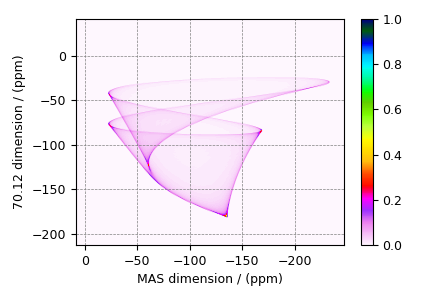
The plot of the simulation.
data = sim.methods[0].simulation
ax = plt.subplot(projection="csdm")
cb = ax.imshow(data / data.max(), aspect="auto", cmap="gist_ncar_r")
plt.colorbar(cb)
ax.invert_xaxis()
plt.tight_layout()
plt.show()
Add post-simulation signal processing.
processor = sp.SignalProcessor(
    operations=[
        # Gaussian convolution along both dimensions.
        sp.IFFT(dim_index=(0, 1)),
        apo.Gaussian(FWHM="0.2 kHz", dim_index=0),
        apo.Gaussian(FWHM="0.2 kHz", dim_index=1),
        sp.FFT(dim_index=(0, 1)),
    ]
)
processed_data = processor.apply_operations(data=data)
processed_data /= processed_data.max()
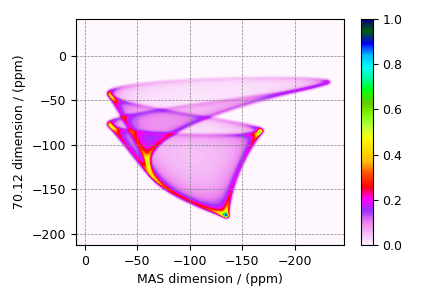
The plot of the simulation after signal processing.
ax = plt.subplot(projection="csdm")
cb = ax.imshow(processed_data.real, cmap="gist_ncar_r", aspect="auto")
plt.colorbar(cb)
ax.invert_xaxis()
plt.tight_layout()
plt.show()
- 1
Shore, J.S., Wang, S.H., Taylor, R.E., Bell, A.T., Pines, A. Determination of quadrupolar and chemical shielding tensors using solid-state two-dimensional NMR spectroscopy, J. Chem. Phys. (1996) 105 21, 9412. DOI: 10.1063/1.472776
Total running time of the script: ( 0 minutes 0.585 seconds)
